No products
To be determined Shipping
0,00 € Total

Blog Categories
Latest Posts
Knowing how to light a cigar with method immediately changes the quality of the tasting experience. A clean start conditions the regularity of combustion, the draw and the expression of aromas. Conversely, a clumsy start can affect taste from the very first puffs.
Lighting a cigar is not something to be rushed. It's a precise ritual, almost an art, that ensures respect for the tobacco and a homogeneous ember. A careful cigar enthusiast gains in pleasure, comfort and control.
This article presents the essential points to know: choosing the right tool, the multi-step technique, mistakes to avoid and the right reflexes to relight a cigar without damaging it. You'll also learn how to adapt your gesture to suit the place and the situation.
The first contact between the flame and the foot of the cigar determines what happens next. If heating is uneven, combustion becomes irregular and the draw may harden on one side. Tasting a cigar therefore begins at the very first second.
A good start releases flavours without damaging the tobacco. The cigar heats up gradually, resulting in a cleaner smoke and a more balanced taste. It also makes the cigar more pleasant to smoke over time.
Lighting a cigar takes time and patience. Unlike a cigarette, you shouldn't try to get the embers to rise too quickly. This slow pace preserves the cigar's character and avoids excessive heat build-up.
This moment also contributes to the overall pleasure. Many enthusiasts associate this gesture with a pause, almost ceremonial, where we concentrate on the quality of the tobacco and the regularity of the draw.
Faulty lighting can burn the wrapper, create black spots or lead to unbalanced combustion. As a result, the cigar may taste harsher, less rounded, and lose some of its aromas. It may be necessary to correct the problem several times to achieve a uniform ember.
The risk is not only aesthetic. Overheating can also alter the cigar's structure and make tasting less comfortable. It's better to take care at this stage, rather than rush it.
To light a cigar, the easiest way is to a butane gas torch lighter a long wooden match or a wick of cedar. These tools offer a more neutral flame than other heat sources, and give greater control over ignition. They are particularly suitable for obtaining a clean ember.
The choice also depends on the context. A lighter with a stable flame facilitates precision, while a long match provides a more traditional gesture. A cedar wick, on the other hand, can add an elegant touch to the tasting experience.
Certain heat sources are not recommended, as they can alter the taste. Petrol lighters, scented candles and chemical matches are all sources of stray odours that can alter the cigar's profile. For the same reason, avoid placing the cigar in direct contact with an aggressive flame.
A good accessory must allow heating without contamination. It's this point that makes the difference between a clean ignition and an imperfect experience. So it's better to choose a simple, reliable tool, rather than a spectacular but unsuitable model.
Indoors, a long match or cedar wick can provide a calmer, more elegant gesture. Outdoors, a torch lighter is more resistant to wind and keeps you in control. Each situation calls for a coherent choice.
The right accessory should also enable you to keep good control of the flame. This adaptation makes lighting more comfortable and regular, whether you're at home, on the terrace or out and about.
Before lighting a cigar, check the cut and general condition of the module. A poorly cut cigar won't draw properly, which hampers combustion right from the start. It's also useful to know whether the cigar has been stored in a stable humidor, as humidity has a direct influence on the result.
A cigar that's too dry will burn too quickly, while one that's too wet will require more effort to ignite. This initial preparation makes it easier to anticipate what's to come and avoid unpleasant surprises.
The correct technique is to bring the flame close to the foot, without actually touching it. Rotate the cigar slowly to heat the entire circumference evenly. This step helps to obtain an even ember and to make the tobacco rise gradually.
The aim is not to burn immediately, but to create a homogeneous base. By doing so, you can better control the temperature rise and preserve the cigar's flavor.
Once you've finished lighting the cigar for the first time, look at the foot of the cigar. A red, even ember is the sign of good lighting. If an area remains black or colder, it's time to reheat that part of the cigar.
This quick check helps avoid asymmetrical combustion from the outset. It also helps maintain a more consistent smoke throughout the tasting experience.
The first mistake is to bring the flame too close to the cigar. This burns the wrapper, heats the tobacco too quickly and harms the taste. Don't try to light too quickly, as this will create an aggressive sensation from the very first puffs.
Another common mistake is not letting the cigar warm up long enough before firing. Without this phase, combustion gets off to a poor start and the draw lacks regularity. The right rhythm is therefore essential.
A poor cut can block the passage of air and complicate lighting. Similarly, a cigar stored in poor conditions will not light as easily. Stability in the humidor plays a key role here.
You should also avoid smoking a cigar that is too damp immediately after taking it out of its storage environment. Tobacco needs to be in a balanced state to ensure clean combustion and a stable taste.
Constantly relighting or correcting the cigar tires it out and can degrade its taste. If you need to relight, do so methodically, without insisting on the same spot for too long. Too many relights can make the cigar hotter and less pleasant to smoke.
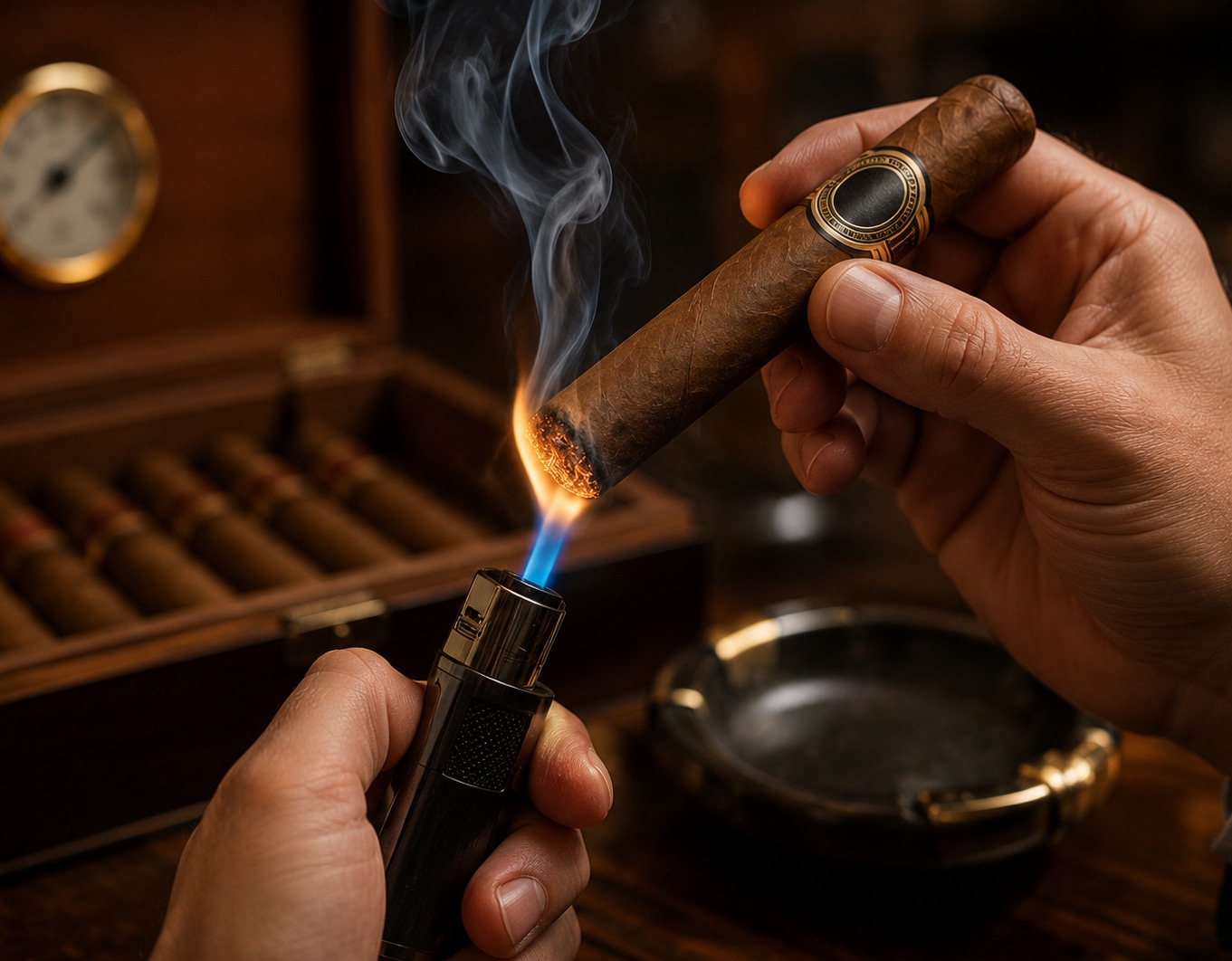
An extinguished cigar can be relit, provided you act calmly. First remove the excess ash, then warm up the foot as you would for a first lighting. The technique remains the same, but requires even greater gentleness.
To limit the degradation of taste, don't wait too long before relaunching the cigar. The more time passes, the more the tobacco cools and loses coherence. A quick relight helps preserve the experience.
A cigar can be relit, but not repeatedly without consequences. Each relight slightly alters the aromatic profile and tasting temperature. It's better to prevent extinction by keeping up a regular rhythm than to have to relight several times.
If you know you're going to interrupt your break, it's better to let the cigar go out properly than to take it up again in a hurry. This often produces a better tasting result.
Indoors, lighting can become a slower, more precise moment. A long match or cedar wick is particularly suited to this atmosphere. The gesture is more discreet, more elegant and often more pleasant for the amateur.
This frame also makes it easier to feel the cigar's behavior. With no wind and no distractions, it's easier to see the ember and correct lighting if necessary.
Outdoors, the wind complicates the task and calls for a more efficient tool. A torch lighter helps protect the flame and maintain good control. You may need to take cover to avoid dispersing the heat before the foot is properly lit.
The context has a direct influence on the method. Adapting your gesture to the place you're in will help you light better and enjoy more consistent tasting.
When you're just starting out, it's best to choose a format that's easy to pull and an accessory that's simple to master. You can also tell more quickly whether lighting is successful by observing the embers and smoke. With a little practice, this gesture becomes natural and much more fluid.
For an amateur, the aim is to obtain a reliable base without rushing. With repetition, ignition becomes a trustworthy benchmark, almost a ritual that you can repeat with precision.
Lighting a cigar correctly is based on three principles: the right tool, a progressive technique and patience. By following these steps, you give the tobacco the best conditions to express its aromas and personality.
Good lighting doesn't require complexity, just attention. It's this attention to detail that allows you to savour each cigar more fully, transforming a simple pause into a real tasting experience. Over time, this gesture becomes simpler, more natural and ever more satisfying.
You always light the open end, i.e. the one that has been cut. The other, closed end is the foot of the cigar and remains intact. It's the cut that creates the draught and starts combustion.
Yes, in most cases, a cigar needs to be cut before lighting. Without a cut, the air doesn't circulate properly, making it difficult to smoke properly. Use a suitable cigar cutter to avoid damaging the wrapper.
It's better to call it smoking a cigar, although the technique is different from that of a cigarette. In general, you don't inhale it into your lungs: you keep the smoke in your mouth to enjoy the aromas. A cigar is more a pleasure to savor than a quick snack.
A cigar that burns badly is often the result of an irregular cut, a too-rapid lighting or a cigar that's too damp. You need to take the time to heat it evenly and keep it in good condition. If the cigar burns unevenly, a little rekindling of the flame can help rebalance the ember.
The price of a cigar lighter varies greatly according to quality and functionality. Simple models start at around a few euros, while quality lighters can cost much more. For a cigar, a disposable flame or torch lighter is often more suitable than a conventional lighter.
 en
en 


