No products
To be determined Shipping
0,00 € Total

Blog Categories
Latest Posts
Visit mold in a cigar cellar is one of the most feared problems for cigar conservation enthusiasts. It can appear discreetly, damage cigars and compromise an entire stock if diagnosed late. To keep cigars in good condition, you need to take action on humidity, ventilation, temperature and regular checks.
It's not just excess water in the air that's a risk. A poorly-adjusted humidification system, a cigar cellar or an inaccurate hygrometer can be enough to create an environment conducive to mold. The tips below will help you spot the problem, clean properly and, above all, prevent it from returning.
The following sections cover the essentials: distinguishing bloom from true mold, understanding the causes, sanitizing storage and setting up a sustainable prevention routine.
Before you panic, you should know that not all white deposits are necessarily mold. Bloom, also known as feathering, is a natural phenomenon associated with tobacco oils. It often appears as a fine, dry, uniform white dust on the wrapper of the cigar.
True mold, on the other hand, looks more like irregular filaments, fluffy areas or greenish, bluish or grayish spots. It sometimes leaves a mark in the cape and may be accompanied by a musty smell. If in doubt, treat the situation as if it were mold, and isolate the cigar concerned.
Bloom is generally easier to remove and does not penetrate the wrapper. Humidor mold, on the other hand, can cling more tightly and reappear if the cause is not corrected. The cigar must therefore be carefully observed before deciding whether or not to keep it.
The most frequent cause is excessively high humidity over a prolonged period. Above 75-80%, the risk increases sharply, especially if the temperature is mild and air circulation poor. A cellar that is too full makes the situation even worse, as cigars breathe less easily.
The humidification system also plays a central role. A humidifier that is too powerful, poorly filled or poorly maintained can maintain an excessively humid environment. Conversely, an undersized unit can create unstable variations that disrupt preservation and encourage condensation.
Large-scale storage without precise control quickly becomes risky. You need to maintain a stable atmosphere, without excess water, and adapt the equipment to the actual volume of the cellar. A good balance between humidification and air circulation remains the best protection against mold.
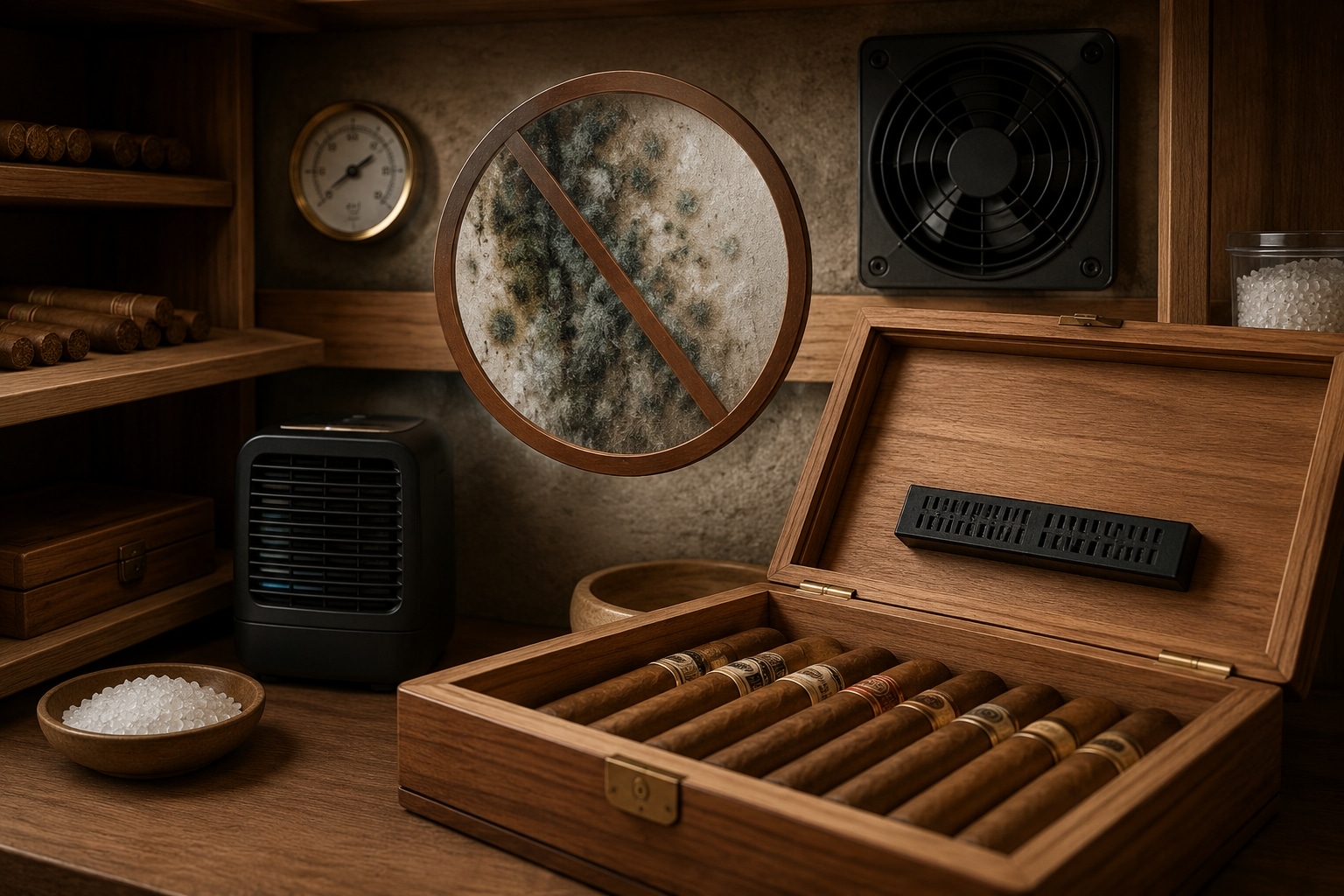
As soon as an outbreak of mould is detected, all cigars should be removed and the interior inspected. Cleaning must be meticulous, as spores can remain in wood, drawers or accessories. The aim is to sanitize the humidor before putting it back into service.
Start by wiping the walls with a clean, dry cloth, then use a soft brush if necessary for marked areas. If the wood is slightly affected, light sanding can help, provided you don't weaken the interior. Allow to dry completely before reinstalling anything.
If contamination is significant, gentle heat may be required to better sanitize surfaces. The idea is not to brutalize the wood, but to eliminate any remaining spores. After cleaning, do not reintroduce the cigars until everything is perfectly dry and healthy.
A cigar heavily affected by mould should be discarded without hesitation. When the filaments have penetrated the wrapper or the smell is clearly altered, it is no longer reasonable to attempt rescue. For mild cases, some enthusiasts isolate suspect pieces, but caution remains the best rule.
The humidifier should also be checked after the incident. The humidifying media, sponge or cartridge may have retained spores or excessively contaminated water. In this case, replacing the humidifier is often safer than attempting a simple rinse.
A well-maintained humidifier greatly reduces the risk of recurrence. Use clean water, renew consumables and avoid prolonged stagnation. This is essential to keep cigars in good condition.
To prevent further contamination, the storage environment needs to be monitored regularly. A reliable hygrometer can be used to check the actual balance, as an incorrect reading can lead to the cellar being over-humidified. It's better to check often than to discover the problem too late.
The ideal level depends on tobacco type and storage habits, but many enthusiasts generally aim for between 65 and 72%. Beyond that, mildew is more likely to occur if heat also sets in. The temperature should remain moderate, ideally around 18 to 21°C.
The room in which the humidor is located also needs to be adapted. A room that's too hot or too humid complicates the entire preservation system. Regular checks, good ventilation and correctly sized equipment offer the best balance to avoid lasting problems.
Regular inspection allows you to take action before the problem spreads. Open the humidor from time to time to check the condition of the cigars, the walls and the operation of the system. A careful look can prevent the loss of several pieces at once.
Look out for discreet signs: an unusual smell, a suspicious white deposit, a wetter area near the humidifier, or cigars stuck together. If you see any anomaly, immediately remove the part concerned and isolate it. This simple habit protects the entire stock and enhances storage quality.
In practice, the best strategy is to use reliable equipment, maintain stable humidification and never let a questionable situation evolve over several days. A well-tuned humidor is distinguished by its stability, not by constant corrections. It's this vigilance that ensures healthy, well-preserved cigars over the long term.
 en
en 


