No products
To be determined Shipping
0,00 € Total

Blog Categories
Latest Posts
The best hygrometry for a cigar is not a single number, but a stable range that respects tobacco quality, aromatic balance and even burning. For most cigar lovers, the aim is to keep cigars in a controlled environment, without excess water or drying out. A well-tuned humidor provides just such stability.
The right level of humidity also depends on the temperature, the type of cigar and the humidification system used. A reliable hygrometer, a suitable humidifier and a few simple gestures are often enough to avoid the most common mistakes. This guide covers the essential points to understand how to ensure optimal preservation.
Here you'll find the benchmarks to follow, the risks to avoid and the settings to favor to keep your cigars in good condition all year round. The idea is not to aim for a perfect theoretical figure, but to know how to adjust and maintain your humidor correctly.
The range most often recommended is between 65% and 75%, with a comfort zone around 68% to 72%. It's within this range that most cigars retain their suppleness, even burn and balanced aromas. A humidor that is too wet or too dry will quickly alter the texture of the tobacco.
The right setting also depends on the smoking style you're looking for. Some enthusiasts prefer a slight drop to encourage ignition, while others prefer a softer hold. In all cases, it's better to aim for a stable range than an exact figure that's hard to maintain.
A cigar stored in the right environment retains its structure without becoming brittle or spongy. If humidity is well controlled, the draw remains more homogeneous and the ashes hold better. This is also essential for preserving the quality of the tobacco's natural oils.
No, because not all cigars react in exactly the same way. Thicker modules may require a little more time to balance out, while some formats are better able to withstand a slight drop. The most important thing is to know your tasting habits and to adjust without brutality.
In a humidor, stability is often more important than over-ambitious settings. A gradual change is preferable to an abrupt correction, as tobacco does not like repeated variations.
Temperature plays a direct role in hygrometer readings and the air's ability to retain humidity. The most frequently recommended range is between 18 and 22°C. In a cigar cellar, this range prevents the indoor climate from drifting too quickly.
Too high a temperature can accentuate the risk of tobacco deterioration and encourage certain parasites. Conversely, too cool an environment can distort the humidifier's measurement and make regulation less predictable. It is therefore essential to monitor both parameters together.
When the temperature rises, the air can contain more water vapor, which alters the perception of relative humidity. In practice, a humidor should not be subject to significant variations between day and night. This stability helps to maintain a good balance.
Place the measuring device in a representative location, without sticking it to the humidifier. Regularly checking the temperature will help you spot any anomalies before they affect the cigars. In some cases, simply moving the humidor is enough to improve the situation.
A good measurement should be taken over time, not just a few minutes. The aim is to guarantee a stable atmosphere, not a flattering point value.
An incorrectly calibrated hygrometer can lead you to believe that everything is fine, when in fact the environment is out of balance. That's why calibration is essential before any serious adjustment. Without it, humidifier settings can become approximate.
The easiest way is to compare your hygrometer's measurement with a reliable reference. Some models are easy to recalibrate, while others require a more methodical check. In any case, you need to check it regularly to ensure a correct reading.
A deviation of just a few points is enough to disrupt cigar preservation. If the sensor displays less than the actual value, you risk overhumidifying unnecessarily. If it displays more, you could unintentionally dry out your humidor.
It's a good idea to check the device after a long period of inactivity, after a shock or when the values seem inconsistent. A reliable hygrometer should be your main point of reference. It's the one that determines the humidifier's adjustment.
It doesn't take much time, but it avoids making the wrong decisions. For a cigar, a few points' difference can make a real difference when tasted.
The choice of humidification system depends on the size of the humidor, the level of precision required and the time you wish to devote to maintenance. Passive models remain simple, while electronic models offer finer control. The most important thing is to choose a humidifier adapted to your actual use.
A good humidification system should diffuse evenly without saturating the air. In small spaces, a system that is too powerful can create an imbalance. Conversely, an undersized humidifier won't be enough to maintain the desired ambience.
Each humidifier has its own function. Passive models are well suited to those who want a discreet solution, while electronic systems reassure demanding users. In all cases, care must be taken to ensure even distribution.
For a small humidor, a correctly sized passive humidifier may suffice. For larger humidors, an electronic humidifier is often more comfortable. The right compromise also depends on the number of cigars stored and the frequency with which they are opened.
Your choice should be consistent with your conservation objectives. A good humidifier doesn't just humidify, it also stabilizes without causing spikes.
The level of recharging depends on the model used, the size of the humidor and the frequency of opening. A humidifier that becomes too light, visibly dry or unresponsive should be recharged before the cigars are affected. It's better to anticipate than wait for a sharp drop.
To recharge correctly, use the liquid recommended by the manufacturer, then leave the humidifier to work without overcharging. Overcharging can create an unbalanced environment. Regular recharging, on the other hand, ensures a stable, serene climate.
Humidifier maintenance should not be neglected, as it has a direct impact on the consistency of the environment. A well-maintained solution ensures greater stability over time. It's a simple gesture, but essential to protect your cigars.
Distilled water is the solution most often recommended for filling a humidifier. It limits deposits, reduces the risk of clogging and avoids the introduction of undesirable minerals. In a humidor, this choice contributes to cleaner, more reliable management.
Tap water can leave residues and disrupt the appliance over the long term. It can also make maintenance more frequent than necessary. For this reason, using an appropriate solution is the best way to ensure stability.
It doesn't add elements that could accumulate in the humidifier or on the walls. This helps to keep the humidifier running smoothly and avoid certain humidification-related problems. Cigars benefit from a healthier environment.
A new humidor must be conditioned before the cigars are placed in it. Wood, especially Spanish cedar, naturally absorbs moisture at start-up. Without this step, the wood can capture the balance intended for the cigars and slow down stabilization.
Conditioning consists of gradually preparing the interior to achieve a coherent environment. This process should not be rushed. The aim is to avoid the humidor pumping out moisture to the detriment of the contents.
Yes, a moderate variation can be normal depending on cigar placement and air circulation. It's not uncommon to see a slight difference between the top and bottom of the humidor. The important thing is that these differences remain limited and regular.
If the discrepancy becomes too pronounced, the cigar distribution, humidifier position or opening frequency should be reviewed. A more homogeneous air flow can then help distribute humidification more evenly.
A brief opening from time to time can help to renew the air. It's not a question of leaving the humidor open for a long time, but of allowing a slight exchange. This can help avoid stagnation and keep the environment more balanced.
Rotating cigars from time to time can also even out their exposure. This is useful when the humidor is very full, or if some formats seem better protected than others. The aim is to guarantee a better distribution over time.
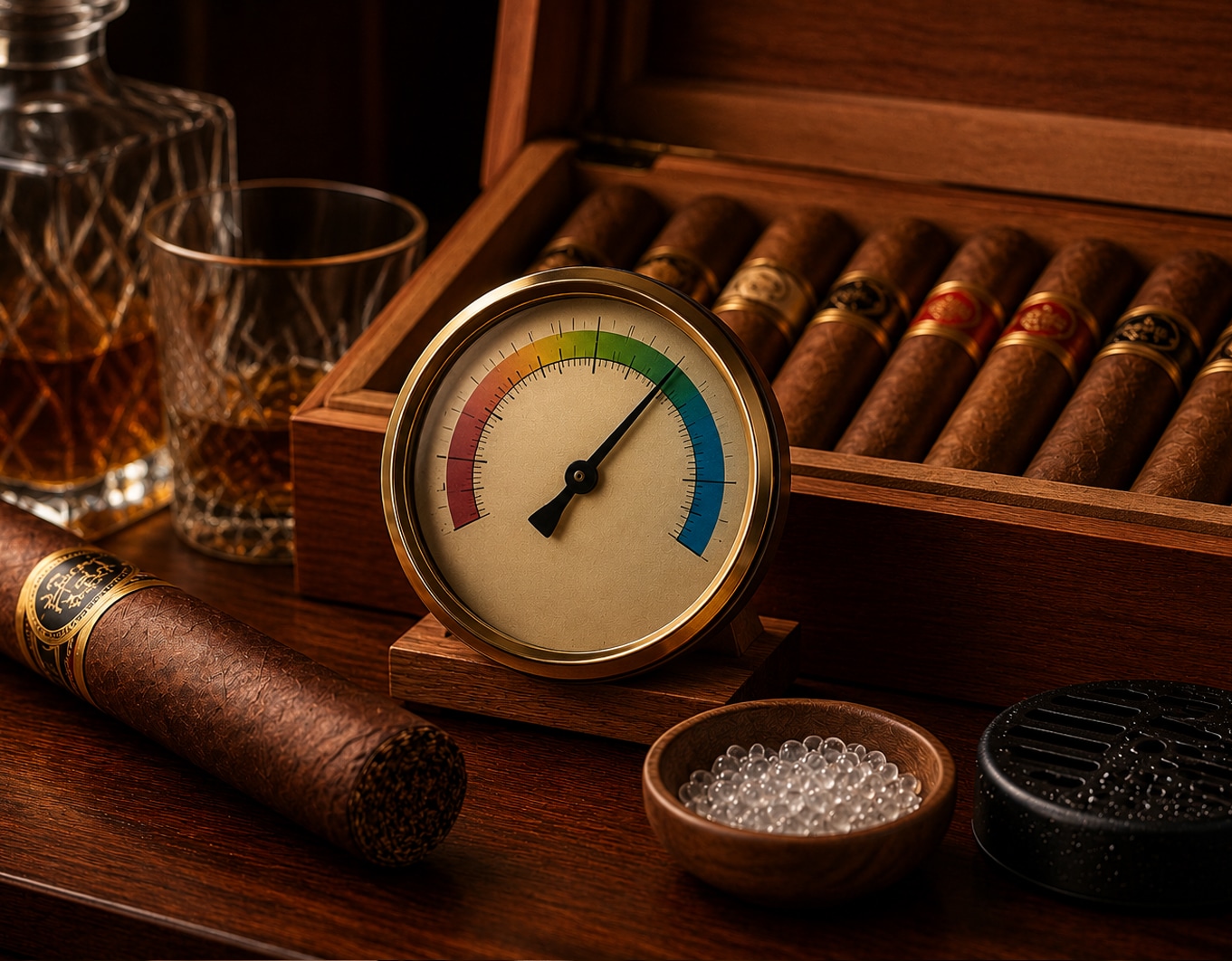
Too dry an environment makes cigars brittle, accelerates loss of aroma and impairs combustion. Conversely, too much humidity makes for difficult smoking, fickle ignition and higher health risks. The right balance is therefore essential to preserve quality.
When not properly regulated, cigars can become unpleasant to smoke or even unfit to enjoy. That's why you need to keep a close eye on your hygrometer, humidifier and temperature. Simple monitoring can often prevent major damage.
In the event of significant drift, you need to take the time to identify the cause before taking action. An incorrectly sized humidifier, a poorly calibrated hygrometer or a poorly conditioned humidor can all become the starting point of the problem. Targeted correction is always more effective than haphazard adjustment.
The more cigars a humidor contains, the more complex the internal balance can become. Volume, frequency of opening and type of storage influence climate stability. It's therefore essential to choose a humidifier that's sufficiently efficient for the actual load.
A well-placed cigar, in a space that is properly filled but not saturated, benefits from a more stable environment. Conversely, storage that is too compact can impede air circulation. The ideal is to keep the organization simple, with easy access to the different formats.
In short, the best hygrometry for a cigar rests on three pillars: a reliable measurement, a suitable humidifier and a stable temperature. If these elements are well managed, cigars remain more regular, more pleasant and better protected over time.
To go further, you simply need to keep an eye on deviations, maintain the humidifier and patiently adjust the settings. A well-maintained humidor doesn't require complicated gestures, but it does require a real sense of rigor. It's this consistency that guarantees quality preservation.
60% is generally considered a little low for optimum preservation, especially over the long term. Cigars can become drier, burn faster and lose aromatic richness. For prolonged rest, it's best to approach a higher, more stable humidity.
72% is not necessarily too high if the temperature is well controlled and the humidor remains stable. On the other hand, if the temperature rises above this level, or if it fluctuates, the risk of mildew, swelling and difficult draw increases. It's best to avoid sudden variations.
A reliable hygrometer is essential for accurate humidor monitoring. Digital models are often easier to read and more convenient for regular monitoring. Ideally, you should choose a device renowned for its stability, and calibrate it if possible.
Yes, solutions like Bovedaare widely used to stabilize humidity in a cigar cellar. They are practical, easy to replace and limit variations. It's a simple option, especially if you're looking for conservation without complicated settings.
 en
en 


